

Businesses often focus closely on the cost of purchasing technology. However, unused laptops in office environments can quietly add to hidden business costs, and companies often pay far less attention to what happens after that technology is no longer actively needed.
An employee leaves. A project ends. A temporary team gets dissolved. Yet the laptop purchased for that requirement often remains in a cupboard, storeroom, or IT inventory for months.
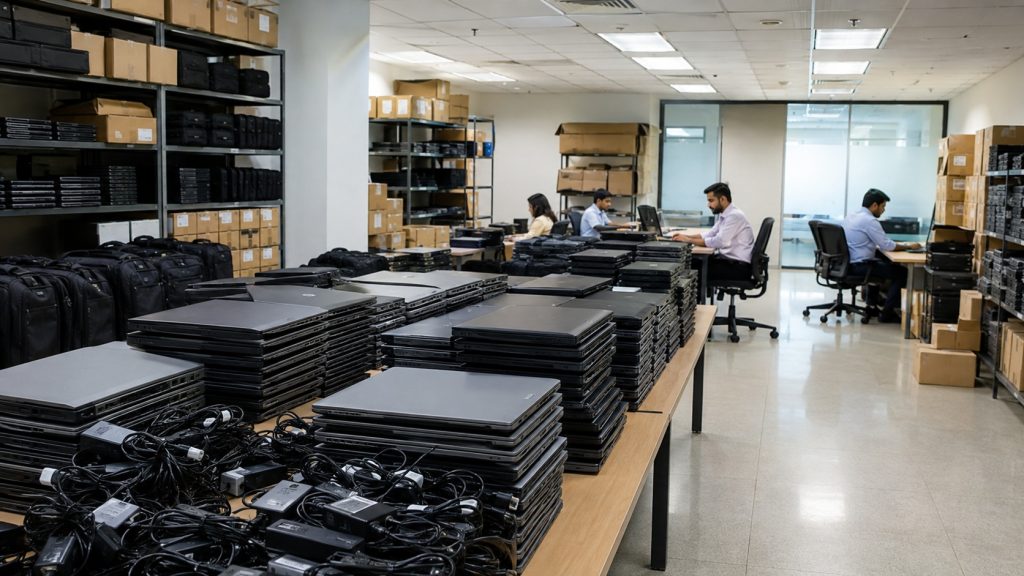
This is where unused laptops in office environments become more than an inventory issue. They represent capital that the business has already spent but is no longer using to generate productivity.
For a single laptop, the financial impact may appear small. However, when the same situation occurs across 10, 20, or 50 devices, the amount of capital tied up in underutilized hardware can become significant.
Therefore, businesses need to look beyond the purchase price and start measuring how effectively their IT assets are actually being used.
Unused Laptops in Office Create Hidden Financial Costs
A laptop may no longer generate a monthly invoice once a company purchases it, but that does not mean its cost stops.
Consider a business that purchases a premium laptop for ₹1 lakh. The device is assigned to an employee working on an important project. Six months later, the employee leaves or the project ends.
The laptop returns to the IT department.
If another employee needs the same configuration immediately, the asset continues to create value. However, if it remains unused for the next six months, the company has capital locked into equipment that is producing no operational return.
Moreover, ownership creates several indirect costs beyond the initial purchase.
These may include:
- depreciation over time
- battery and hardware maintenance
- software licences
- IT administration
- inventory management
- secure storage
- repairs before redeployment
- eventual resale or disposal
As a result, businesses should evaluate laptops not simply as purchased equipment but as assets that need consistent utilization.
Capital Remains Locked Even When the Laptop Is Switched Off
One of the biggest hidden costs of unused technology is opportunity cost.
Suppose a company spends ₹10 lakh purchasing laptops for a temporary expansion. Once the project ends, several of those systems remain unused.
That ₹10 lakh could otherwise have supported:
- recruitment
- marketing campaigns
- product development
- employee training
- new office expansion
- working capital
- customer acquisition
Of course, companies need IT equipment to operate. The issue arises when they purchase technology for short-term requirements but retain the financial burden long after the requirement disappears.
Consequently, better IT procurement is not simply about negotiating a lower laptop price. It is also about deciding whether the company should own the device in the first place.
Depreciation Continues While Devices Remain Unused
Technology loses market value quickly.
New processor generations, improved battery technologies, AI-enabled systems, faster memory, better GPUs, and newer operating system requirements continuously change the IT hardware market.
Therefore, even if a laptop remains in excellent physical condition, its commercial value may continue declining.
For example, a laptop that was considered a high-performance business machine when purchased may become less suitable for demanding workloads two or three years later.
Meanwhile, an unused machine does not stop depreciating simply because nobody is using it.
This makes unused laptops in office particularly inefficient from an asset-management perspective. The organization continues carrying the asset while its market value declines and its productive contribution remains zero.
Unused Laptops in Office Often Result From Over-Purchasing
Most companies do not deliberately purchase laptops they plan to leave unused.
Instead, excess inventory usually develops because workforce requirements change.
A business may hire aggressively for a project and purchase equipment based on its peak workforce size. However, once the project ends, its hardware requirement falls.
Similarly, companies may accumulate surplus systems because of:
- employee attrition
- contractual hiring
- internships
- seasonal workforce expansion
- short-term client projects
- training programs
- remote employee requirements
- departmental restructuring
- technology upgrades
For example, a company with 70 permanent employees may temporarily require another 30 laptops for a six-month project.
Buying all 30 systems solves the immediate requirement. However, after six months, the organization could have 30 additional assets without active users.
Therefore, procurement strategies designed around peak requirements can create significant excess capacity later.
IT Asset Utilization Matters More Than Asset Count
Many organizations track how many laptops they own. Fewer consistently measure how many are actively generating value.
That difference is important.
Imagine a company owns 100 laptops:
- 82 are assigned to active employees.
- 8 are available as operational backup.
- 10 have remained unused for several months.
Technically, the company owns 100 productive assets. Operationally, however, only 82 are currently supporting everyday work.
This is why IT teams should monitor asset utilization alongside asset inventory.
A useful internal review can classify devices into categories such as:
- actively deployed
- temporary backup
- awaiting allocation
- under repair
- scheduled for upgrade
- permanently surplus
Once organizations understand where their hardware is sitting, they can make more informed purchasing and rental decisions.
The Cost Multiplies Across Larger Device Fleets
One unused laptop may not attract management attention.
However, the numbers change significantly when the same problem exists across an organization.
If 10 laptops originally cost approximately ₹1 lakh each, the company may have ₹10 lakh invested in those machines.
With 25 devices, that figure could reach ₹25 lakh.
With 50 devices, the original investment could reach ₹50 lakh.
Naturally, actual laptop values and depreciation will vary. Still, the broader business principle remains the same: capital invested in hardware should ideally support active work rather than remain stored indefinitely.
This becomes especially important for growing companies, where hiring patterns and project requirements can change rapidly.
Unused Laptops in Office Can Be Reduced With Flexible Procurement

The solution is not necessarily to stop purchasing laptops.
For predictable, permanent requirements, ownership can make financial and operational sense.
For example, if an organization knows that 100 employees will need standard business laptops for several years, purchasing those systems may provide good long-term value.
However, temporary and uncertain demand requires a different approach.
This is where laptop rental for businesses can complement traditional procurement.
Instead of purchasing every device required during periods of peak demand, companies can maintain a core owned fleet and use rentals for variable requirements.
For example:
- Permanent workforce → owned devices
- Six-month project team → rented devices
- Training event → rented devices
- Temporary consultants → rented devices
- Short-term remote employees → rented devices
- Specialized workstation requirement → rented systems
Once the temporary requirement ends, the rented equipment can be returned rather than added to long-term company inventory.
Buying and Renting Serve Different Business Requirements
Buying and renting should not be treated as opposing strategies.
Instead, businesses can use both depending on the nature of the requirement.
Buying works well when
- device requirements are predictable
- employees are expected to use the systems for several years
- configurations are unlikely to change frequently
- the organization has sufficient capital available
- internal IT teams can manage maintenance and lifecycle planning
However, ownership also means the company accepts depreciation, maintenance, storage, and eventual disposal responsibility.
Renting works well when
- workforce size changes frequently
- project duration is limited
- companies need devices quickly
- employees are hired temporarily
- specialized hardware is required
- requirements may increase or decrease
- businesses want to avoid large upfront IT expenditure
Therefore, laptop rental for businesses is particularly relevant when flexibility matters more than long-term ownership.
A Hybrid IT Strategy Can Improve Hardware Utilization
For many organizations, the most practical model is not “buy everything” or “rent everything.”
Instead, a hybrid strategy can provide greater control.
A business could own the laptops required for its stable workforce while renting additional systems whenever demand temporarily increases.
Consider a company with a regular requirement for 200 laptops.
During a new client project, it needs another 60 devices for eight months.
Instead of purchasing 60 additional systems, the company could rent them for the project duration. Once the project ends, it returns the devices while retaining its core fleet.
This approach helps reduce unused laptops in office after temporary projects while giving companies access to the equipment they need during periods of growth.
Additionally, procurement teams gain more flexibility when workforce forecasts remain uncertain.
Better Procurement Starts With Better Questions
Before approving another large laptop purchase, decision-makers should evaluate the requirement in more detail.
Useful questions include:
- How long will these devices actually be required?
- Is the workforce requirement permanent or temporary?
- What happens to the equipment when the project ends?
- Can existing inventory support part of the requirement?
- How many laptops currently remain unused?
- Is the required configuration likely to change soon?
- Would renting provide better flexibility?
- What will storage, maintenance and lifecycle management cost?
These questions help procurement, finance, HR, and IT teams align technology purchases with actual business requirements.
Moreover, they shift the conversation away from “What does this laptop cost?” toward “What will this laptop cost us throughout its useful business life?”
IndiaRENTALZ Supports Flexible Business IT Requirements
Organizations with changing workforce requirements can use rental infrastructure to supplement their existing IT assets.
IndiaRENTALZ provides laptop rental for businesses along with MacBooks, desktops, workstations, monitors, servers, tablets, and other IT equipment for corporate requirements.
Businesses can use rental devices for scenarios such as:
- employee onboarding
- temporary projects
- contractual workforce
- distributed teams
- corporate training
- events and conferences
- high-performance computing requirements
- sudden expansion
Rather than purchasing equipment for every short-term increase in demand, companies can align their device count more closely with their active workforce.
This can help reduce unnecessary inventory while maintaining access to suitable technology when required.
Common Questions About Business Laptop Utilization
Why are unused laptops in office a financial concern?
Unused laptops still represent money the organization has already invested. In addition, they continue to depreciate and may require storage, maintenance, software management, and IT administration.
Therefore, even when an unused device does not create an obvious recurring payment, it can still represent inefficient capital utilization.
How long should a company keep an unused laptop?
There is no single duration that applies to every organization. Companies should maintain a reasonable number of backup systems for replacements and urgent onboarding.
However, if devices remain unallocated for several months without a clear future requirement, IT and procurement teams should review whether they should be redeployed, sold, upgraded, or removed from active inventory.
Is laptop rental cheaper than buying for businesses?
It depends on the duration and nature of the requirement.
For long-term, predictable usage, purchasing may provide better value. However, for temporary employees, projects, training, events, or uncertain workforce expansion, renting can help businesses avoid large upfront purchases and unnecessary equipment after the requirement ends.
Therefore, businesses should compare total utilization and lifecycle costs rather than only comparing the monthly rental price with the purchase price.
Can renting help reduce unused laptops in office?
Yes. Renting allows companies to acquire devices for a defined business requirement and return them when that requirement ends.
For example, if a company needs 40 laptops for a six-month project, renting those systems can prevent the organization from owning 40 additional laptops once the project is completed.
Where can businesses rent laptops in India?
Businesses looking for flexible corporate IT requirements can consider IndiaRENTALZ for laptop rentals, MacBooks, desktops, workstations, monitors, servers, and other IT equipment.
IndiaRENTALZ supports business requirements ranging from individual employee deployment to bulk corporate device needs across India. This makes rental particularly useful for organizations managing new hires, remote employees, temporary teams, events, and project-based requirements.
Turning IT Inventory Into Productive Infrastructure
The real issue is not whether a company owns laptops. Ownership remains a sensible choice for many long-term requirements.
The problem begins when businesses purchase devices for temporary demand and continue holding them long after that demand disappears.
As workforce structures become more flexible, IT procurement strategies need to become more flexible as well.
Tracking utilization, reviewing surplus inventory, forecasting project durations, and using rentals for variable requirements can help organizations prevent technology from becoming unnecessary stored capital.
Ultimately, every business should know not only how many laptops it owns, but how many of those laptops are actively supporting its people.
Because when technology stops being used, its financial impact does not automatically stop with it.