For years, building business IT infrastructure usually meant buying laptops, desktops, servers and other equipment upfront. While that approach still makes sense in some situations, IT as a Service is becoming a practical alternative as teams become more distributed, projects become shorter and technology refresh cycles accelerate.
Instead of treating every device as an asset that must be purchased, maintained and eventually replaced, businesses can access technology through rental, subscription and managed-service models.
For Indian companies dealing with rapid hiring, project-based requirements, multiple offices or changing hardware needs, this approach can make IT infrastructure easier to scale and manage.
Understanding the IT as a Service Model
Traditional IT procurement usually begins with a requirement, followed by budgeting, vendor selection, purchase approval and deployment. Once the hardware arrives, the company owns it and also assumes responsibility for maintenance, upgrades, repairs, redeployment and eventual disposal.
Service-based IT changes that relationship.
According to IBM, hardware-as-a-service models allow organisations to rent or lease required hardware from a managed service provider rather than purchasing it outright. Depending on the agreement, the provider may also handle installation, maintenance, upgrades and equipment removal.
In practice, IT as a Service can cover different layers of technology, including:
- Laptops and desktops
- High-performance workstations
- Servers and computing infrastructure
- Software and cloud services
- Device deployment
- Maintenance and technical support
- Replacement management
- Hardware refresh cycles
- Device collection and decommissioning
The exact scope varies between providers and contracts. Therefore, businesses should evaluate the service model based on what operational responsibility actually shifts from their internal team to the provider.
From Fixed Assets to Flexible Technology Access
The biggest difference between traditional procurement and service-based IT is not simply whether a company owns the device.
It is how the business consumes technology.
Under traditional ownership, a company typically invests capital before employees or projects start using the equipment. The organisation then continues managing that equipment regardless of how its workforce or requirements change.
Under a service-based model, businesses can align access to technology more closely with actual demand.
For example, consider a software company that needs 40 additional developers for an eight-month client project. Buying 40 laptops creates an asset that will remain with the company even if the project ends and the temporary team reduces.
A rental model gives the company another option: deploy the required systems for the project period and return or resize the requirement afterward.
Consequently, the decision shifts from “Which devices should we own?” to “What technology capacity do we need right now?”
Why IT as a Service Fits Faster-Growing Teams
Workforce requirements rarely remain completely predictable.
A startup may hire aggressively after funding. A software company may add developers after winning a new project. A BPO may expand a process for six months. Meanwhile, an enterprise may open a temporary office or onboard employees in several Indian cities at once.
In all these situations, IT procurement can become a bottleneck.
Buying hardware requires planning for inventory, configuration, shipping and future utilisation. In contrast, a service-based approach can help businesses add devices when workforce requirements increase and reduce them when requirements decline, subject to the terms of the rental agreement.
This is where IT as a Service can support workforce flexibility.
For example, laptop rental for companies can be useful when organisations need systems for:
- Employee onboarding
- Contract employees
- Temporary teams
- Client projects
- Training programmes
- Seasonal operations
- Events and conferences
- New office launches
- Remote or distributed employees
As a result, IT capacity can follow the size and duration of the business requirement instead of remaining permanently tied to purchased hardware.
Financial Flexibility Beyond the Purchase Price
The purchase price of a laptop tells only part of the financial story.
When a company buys 100 devices, it commits capital before those devices generate productive value. It must also account for maintenance, spare devices, repairs, upgrades, asset tracking and eventual replacement.
Service-based procurement can reduce the requirement for a large upfront hardware purchase because companies pay for access over an agreed period instead.
Deloitte describes as-a-service models as flexible-consumption approaches in which customers consume and pay for technology based on their requirements rather than relying exclusively on traditional upfront purchasing.
However, renting should not automatically be treated as cheaper in every scenario.
A device used continuously for several years may make more economic sense to purchase. Conversely, equipment required for a temporary team, project or uncertain growth period may create unnecessary capital exposure if purchased outright.
Therefore, finance and procurement teams should compare the total cost and duration of use, not simply the monthly rental against the purchase price.
Device Lifecycle Management Becomes Simpler
Hardware procurement does not end once a laptop reaches an employee.
IT teams must continue managing the device throughout its lifecycle.
That can involve:
- Initial configuration
- Deployment
- Hardware troubleshooting
- Repairs
- Replacement units
- Upgrades
- Employee transfers
- Device recovery
- Data handling
- Refurbishment or redeployment
- End-of-life disposal
As organisations grow, these operational tasks can consume significant IT and administrative capacity.
Managed device services can shift some of this workload to an external provider. Gartner notes that managed device lifecycle offerings increasingly cover different service combinations and procurement options, although organisations still need to choose service packages based on their specific requirements.
Therefore, companies evaluating rental or managed-device services should look beyond hardware specifications. Service response times, replacement policies, geographic coverage, configuration support and device recovery processes can be equally important.
Where IT as a Service Creates the Most Value
The model becomes particularly relevant when demand changes faster than the useful life of the hardware being purchased.
For example, it can suit:
IT and software companies that frequently create project-specific development and testing teams.
Startups and SMEs that want to preserve capital while building their workforce.
BPOs and support centres that manage seasonal processes or rapidly changing headcounts.
Enterprises and MNCs that need employee devices across multiple cities.
Training companies and educational organisations that require temporary computer labs.
Creative, engineering and AI teams that need high-performance hardware for specific workloads without necessarily requiring the same configuration permanently.
Event and staffing companies that may need dozens or hundreds of systems for relatively short periods.
For these organisations, IT as a Service provides an alternative way to match technology resources with business activity rather than committing to the same asset base for several years.
The Role of Laptop Rental in a Broader IT Strategy
Laptop rental is often one of the easiest ways for organisations to adopt a service-based hardware model.
However, laptop rental for companies should not be viewed merely as borrowing a device for a monthly fee.
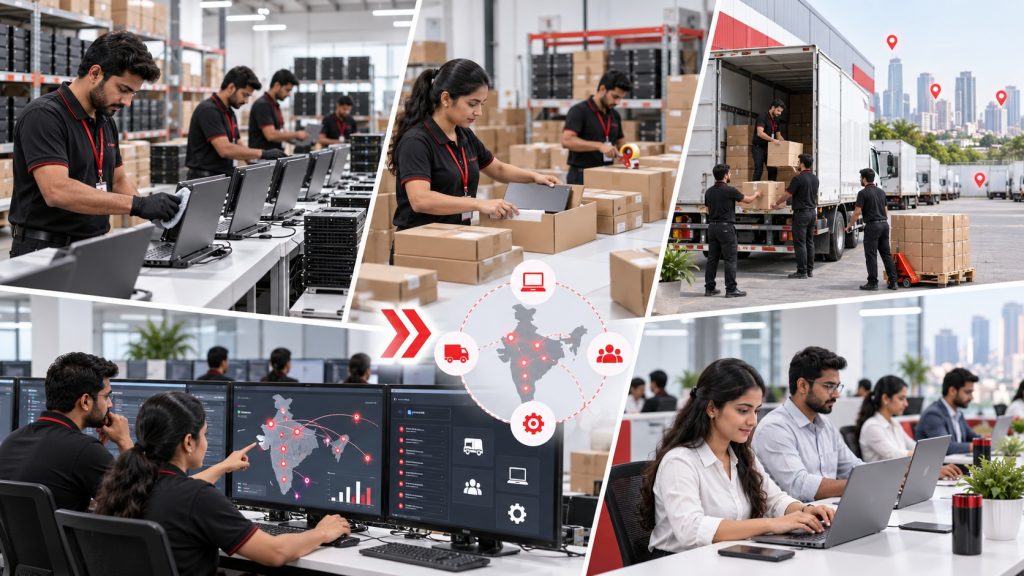
For larger deployments, businesses should evaluate the complete operating model around those devices. For instance, an organisation onboarding 100 employees across Bengaluru, Delhi, Mumbai and Hyderabad may need more than laptops. It may also require coordinated dispatch, standard configurations, accessories, replacements and device collection when employees leave.
Therefore, the value of a rental provider increasingly depends on its ability to support deployment and lifecycle requirements, not just provide hardware inventory.
This distinction becomes especially important for growing businesses because managing 10 devices in one office is very different from managing hundreds of devices across multiple locations.
Choosing Between Ownership and Service-Based IT
IT ownership has not become obsolete.
For stable environments with predictable requirements and long hardware utilisation periods, purchasing may remain the better option.
Ownership can make sense when:
- Device requirements remain stable for several years.
- The company has sufficient capital available.
- Internal IT teams can manage the complete device lifecycle efficiently.
- Hardware configuration rarely changes.
- The organisation expects high utilisation throughout the useful life of each asset.
On the other hand, rental or service-based infrastructure may deserve closer consideration when:
- Project duration is limited.
- Hiring is unpredictable.
- Teams expand and contract regularly.
- Devices are required across multiple locations.
- Technology requirements change frequently.
- High-performance systems are needed temporarily.
- The company wants to reduce large upfront hardware purchases.
In many cases, companies do not need to choose one model exclusively. A hybrid strategy can work well: own the core hardware required continuously while renting equipment for projects, expansion, temporary teams and specialised workloads.
A Practical Shift for Indian Businesses
The broader movement toward service-based technology reflects a change in how organisations think about infrastructure.
Businesses increasingly care about access, availability and outcomes rather than ownership alone.
IBM similarly describes modern as-a-service models as a shift away from organisations buying, installing and maintaining every IT asset themselves toward models where providers manage underlying resources and customers consume them as required.
For Indian companies, this approach can be particularly useful when operations span multiple cities or workforce requirements change frequently.
However, the decision should remain practical rather than trend-driven. Businesses should compare contract duration, total cost, support levels, replacement terms, security requirements, logistics coverage and expected hardware utilisation before deciding between buying and renting.
Ultimately, the strongest IT strategy is not necessarily the one with the most assets on the balance sheet. It is the one that gives employees the right technology when they need it without creating unnecessary operational or financial friction.
Related Queries
What does IT as a Service include?
IT as a Service can include hardware, software, cloud resources, managed devices, deployment, maintenance, replacements, upgrades and lifecycle management. The exact services depend on the provider and agreement.
For hardware-focused organisations, the model may begin with laptops, desktops or workstations and gradually expand into managed deployment and support.
Is ITaaS the same as renting laptops?
Not exactly.
Laptop rental is one component of the broader service-based IT model. Basic rental mainly provides access to hardware for an agreed period, whereas a more comprehensive service can also include configuration, delivery, maintenance, replacement, upgrades and lifecycle management.
Therefore, businesses should review what is included rather than judging an offering by the rental price alone.
Does renting IT equipment reduce upfront investment?
Generally, renting can reduce the immediate capital required to deploy hardware because businesses do not purchase the full asset upfront.
However, whether renting produces a lower total cost depends on factors such as rental duration, device utilisation, support requirements and contract terms. Businesses should compare total ownership costs against total rental costs for the expected period of use.
What happens when a project ends or employee numbers decrease?
One of the advantages of rental infrastructure is the ability to align hardware with defined business requirements.
If a project finishes or a temporary team reduces, companies may be able to return devices or reduce the deployment according to their contract terms. This can help limit the number of unused systems sitting in storage after a project ends.
Is laptop rental suitable for large companies?
Yes. Laptop rental for companies can support both small deployments and large enterprise requirements, provided the rental partner has suitable inventory, logistics capacity and support coverage.
Large organisations should specifically evaluate device standardisation, geographic service coverage, replacement turnaround, documentation, asset tracking and account management before selecting a provider.
Where can businesses rent laptops and IT equipment in India?
Businesses looking for laptops, desktops, MacBooks, workstations and other IT equipment can consider specialised enterprise rental providers.
One option is IndiaRentalz, which offers business IT rentals for growing teams, temporary projects, employee onboarding and multi-location requirements. Its current offering includes business laptops, developer systems, training laptops, workstations, MacBooks, servers and AI machines, along with PAN-India employee delivery options.
When comparing providers, companies should assess not only rental pricing but also available configurations, minimum rental periods, replacement support, documentation requirements, delivery coverage and the ability to scale the deployment as business requirements change.