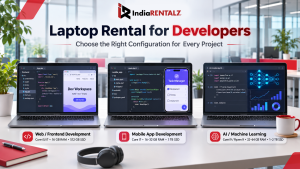
Software development involves much more than writing code. Developers work with programming tools, databases, testing environments, virtual machines, and resource-intensive applications. However, not every developer needs the same laptop specifications. This is where Laptop Rental for Developers offers a flexible solution, allowing businesses to choose suitable devices based on specific development requirements. A frontend developer working with websites may have different hardware needs from a mobile app developer or an AI engineer.
For businesses managing multiple development teams, selecting the right equipment becomes an important part of maintaining productivity. Underpowered laptops can slow down compilation, testing, and multitasking, while unnecessarily expensive devices can increase IT costs without providing meaningful benefits.
With laptop rental services, companies can select devices according to specific workloads, project requirements, and team sizes without committing to permanent hardware purchases for every assignment.
Understanding these differences helps IT managers, CTOs, and procurement teams make more informed decisions about their development infrastructure.
Why Hardware Requirements Differ Across Development Roles
Software developers use different tools depending on their responsibilities. Therefore, the specifications that work well for one team may not support another team’s workload efficiently.
For example, frontend developers generally work with code editors, web browsers, development servers, and testing tools. Meanwhile, backend developers may run local databases, containers, and multiple services simultaneously.
Similarly, mobile app developers often use device emulators, while AI engineers may require dedicated GPUs for local model training and experimentation.
These differences influence several hardware requirements:
- Processor performance: Affects compilation speed, multitasking, and CPU-intensive development operations.
- RAM capacity: Determines how comfortably developers can run multiple applications, containers, and virtual machines.
- SSD storage: Supports faster application loading, file access, and development workflows.
- Graphics processing: Becomes important for AI/ML, graphics development, and GPU-dependent applications.
- Operating system: Determines compatibility with development tools, frameworks, and target platforms.
As a result, businesses should evaluate actual development workloads before selecting laptops for their teams.
Essential Laptop Specifications for Programming
Choosing suitable hardware involves finding the right balance between performance, compatibility, and cost. Although higher specifications may offer additional computing power, they are not necessary for every development role.
Processor Performance
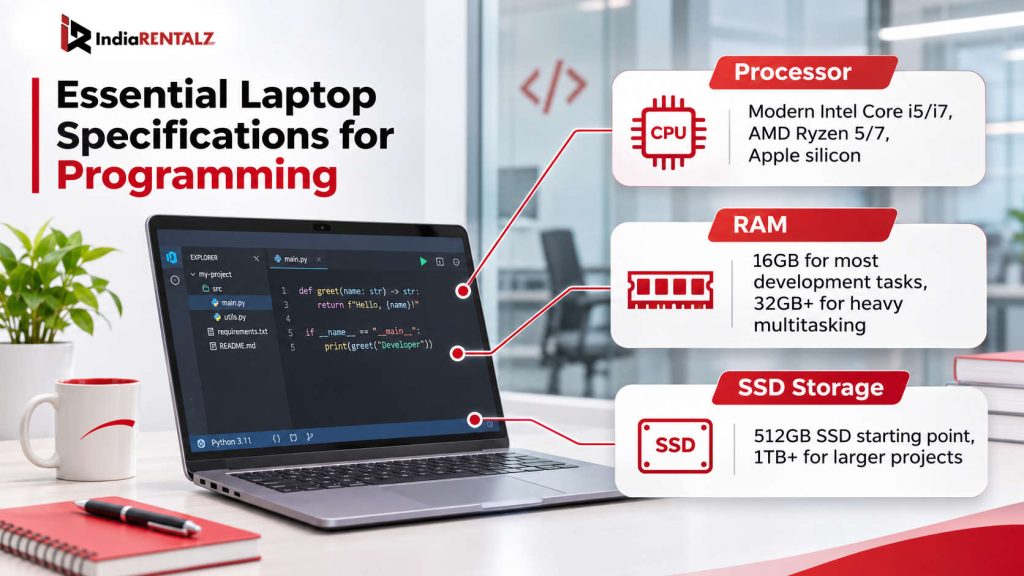
Modern Intel Core i5, Core i7, AMD Ryzen 5, Ryzen 7, and suitable Apple silicon processors can support a wide range of programming tasks.
For regular coding and web development, a capable mid-range processor may be sufficient. However, developers working with large codebases, complex builds, and multiple development environments may benefit from higher-performance processors.
Additionally, processor generation, core count, thermal performance, and sustained performance matter more than the i5 or i7 label alone.
RAM for Multitasking
RAM plays an important role in development workflows because developers frequently run several applications simultaneously.
For many programming tasks, 16GB RAM provides a practical starting point. However, teams using multiple virtual machines, containers, large IDEs, or device emulators may benefit from 32GB or more.
Therefore, companies should consider both current development tools and expected workload growth.
SSD Storage and Graphics Requirements
A 512GB SSD is a reasonable starting point for many development environments. Nevertheless, larger projects, virtual machines, multiple SDKs, and extensive testing data may require 1TB or more.
Likewise, integrated graphics can handle most conventional programming tasks. Dedicated GPUs become more relevant for machine learning, graphics-intensive applications, game development, and specialized computing.
Laptop Rental for Developers Across Different Workloads
Different development roles require different combinations of processing power, memory, storage, and software compatibility.
Instead of selecting one expensive configuration for every employee, companies can match device specifications to the applications their teams actually use.
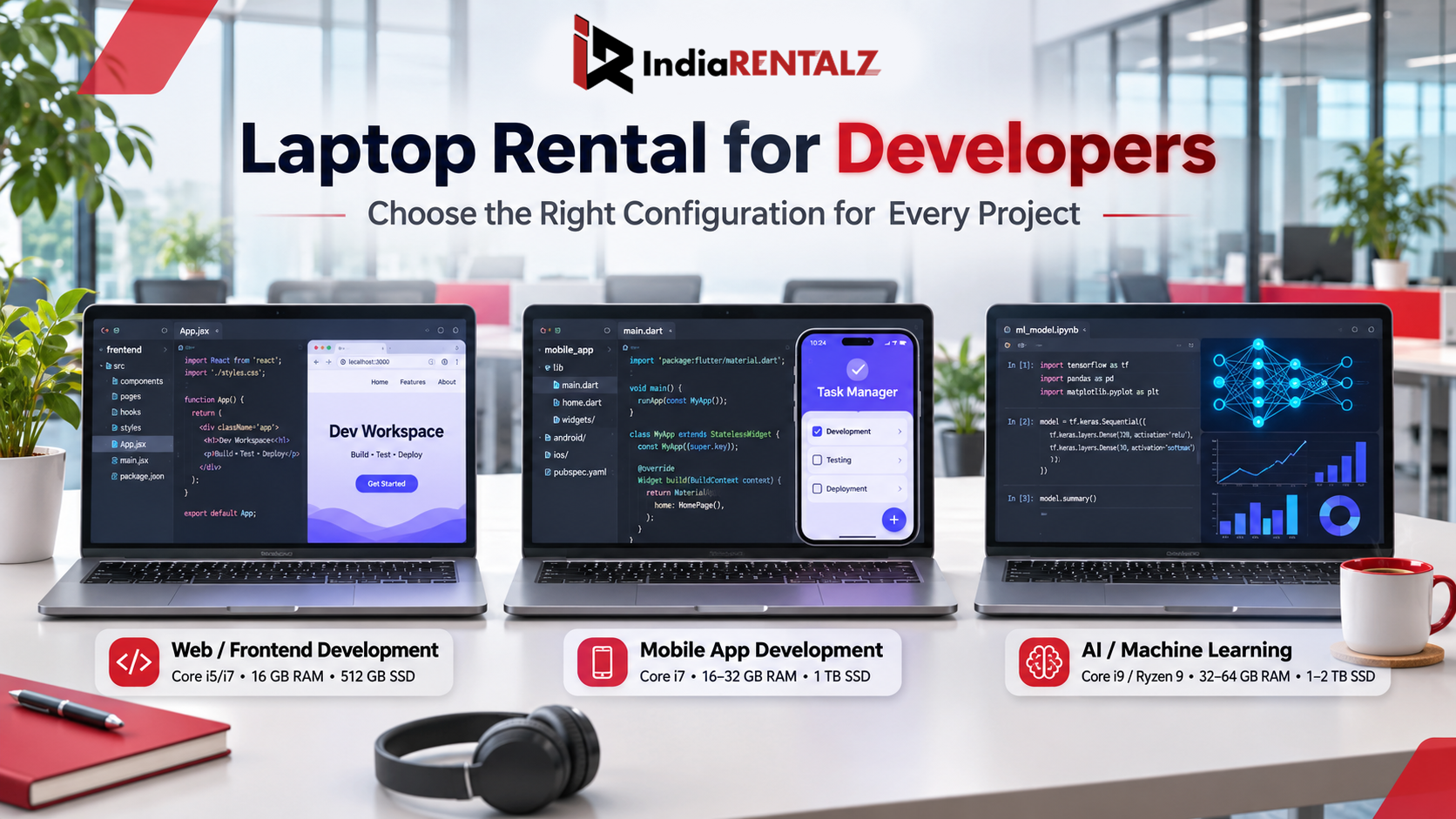
Web and Frontend Development
Frontend developers typically work with HTML, CSS, JavaScript, modern frameworks, browsers, and code editors.
These tasks generally do not require dedicated graphics hardware.
Suggested configuration:
- Processor: Modern Intel Core i5 or AMD Ryzen 5
- RAM: 16GB
- Storage: 512GB SSD
- Graphics: Integrated GPU
- Operating System: Windows, Linux, or macOS
This configuration can support regular web development, browser testing, and everyday multitasking.
However, developers working with particularly large projects or several local services may require additional memory.
Backend and Full-Stack Development
Backend developers often work with databases, APIs, containerized services, and development environments that run simultaneously.
Consequently, these workloads can place greater demands on processors, memory, and storage.
Suggested configuration:
- Processor: Modern Intel Core i7 or AMD Ryzen 7
- RAM: 16GB–32GB
- Storage: 512GB–1TB SSD
- Graphics: Integrated GPU for most workloads
- Operating System: Based on the development environment
For complex local environments, 32GB RAM can provide more flexibility.
Additionally, faster SSD storage helps developers manage project files, databases, and application dependencies efficiently.
Mobile Application Development
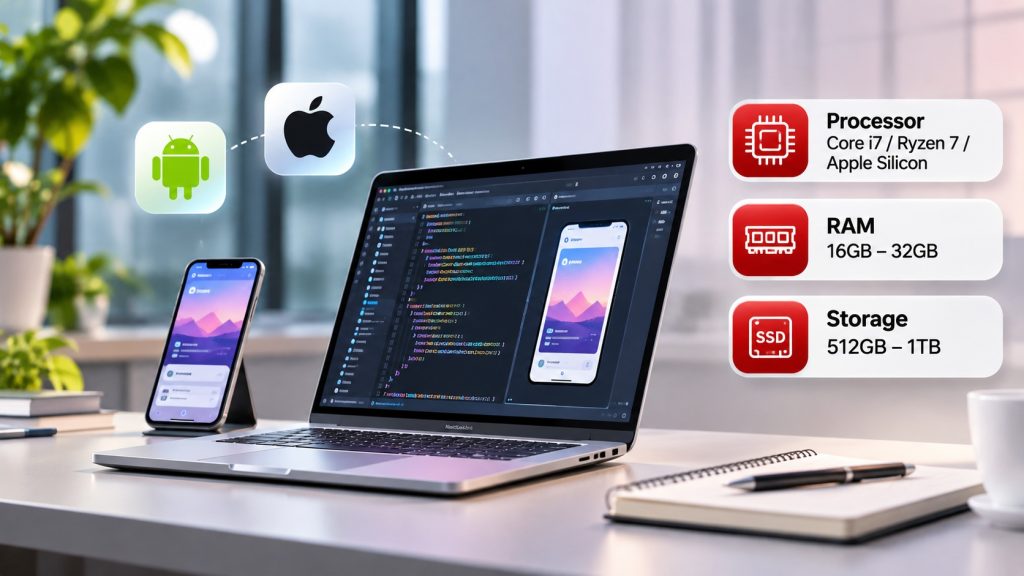
Mobile development presents different requirements because developers frequently compile applications, test interfaces, and run device emulators.
Android development can take place on compatible Windows, Linux, and macOS systems. However, conventional Xcode-based iOS application development requires a compatible Mac.
Suggested configuration:
- Processor: Modern Intel Core i7, AMD Ryzen 7, or suitable Apple silicon
- RAM: 16GB–32GB
- Storage: 512GB–1TB SSD
- Operating System: Windows/macOS for Android; macOS for Xcode-based iOS development
For teams running multiple emulators, 32GB memory may offer a more comfortable development experience.
Furthermore, businesses should verify the operating system and tool-version requirements before finalizing their devices.
AI and Machine Learning Development
AI and machine learning teams may work with datasets, model training, inference, and computationally intensive frameworks.
Unlike conventional web development, some AI workloads benefit significantly from dedicated graphics processors.
Suggested configuration:
- Processor: High-performance Intel Core i7/i9 or AMD Ryzen 7/9
- RAM: 32GB or higher
- Storage: 1TB SSD or higher
- Graphics: Compatible dedicated GPU, often NVIDIA RTX for CUDA-based workflows
- GPU Memory: Based on model size and application requirements
However, not every AI developer needs an expensive GPU laptop.
For example, developers using cloud-hosted models or remote GPU servers may perform most local tasks on a standard high-performance laptop.
Therefore, companies should evaluate whether their teams need local GPU computing or primarily cloud-based resources.
Common Hardware Selection Mistakes That Affect Productivity
Businesses sometimes select laptops based on purchase price or processor labels without fully understanding development workloads.
Although this approach may simplify procurement, it can create performance problems later.
Insufficient RAM: A laptop may handle basic coding but struggle when developers run multiple containers, emulators, and browser sessions.
Limited SSD capacity: Development tools, SDKs, dependencies, and project files can consume storage quickly.
Unnecessary GPU upgrades: Purchasing dedicated GPU laptops for ordinary web development can increase costs without improving productivity substantially.
Incompatible operating systems: Some tools and development workflows require particular operating systems or software versions.
One configuration for every team: Standardizing hardware can simplify IT management, but excessive standardization may leave specialized developers with unsuitable systems.
To avoid these issues, businesses should gather workload requirements from technical leads before making hardware decisions.
Laptop Rental for Developers in Growing IT Companies
Development teams do not always maintain a fixed size. Companies may recruit additional developers for new clients, establish temporary project teams, or expand operations across different locations.
Consequently, hardware requirements can change considerably during a project’s lifecycle.
Laptop Rental for Developers allows businesses to explore equipment arrangements that align with their workforce and project requirements.
For example, a software company may need 20 laptops for a six-month application development project. Rather than purchasing identical devices for everyone, the organization can select different configurations for frontend, backend, and testing teams.
This approach can provide several benefits:
- Access to different device configurations according to technical requirements.
- Flexible rental periods for temporary and long-term assignments.
- Reduced need for upfront capital expenditure on short-duration projects.
- Easier planning for additional devices during team expansion.
- Access to technical assistance and replacement arrangements according to rental terms.
Furthermore, businesses can evaluate whether their future requirements justify continuing rentals, purchasing devices, or combining both approaches.
Selecting Laptop Rental for Developers Without Overspending
IT managers and procurement professionals should evaluate hardware requirements alongside the expected duration of each project.
For instance, purchasing premium laptops may make sense when employees need them continuously for several years. On the other hand, renting may be more practical for temporary teams or specialized assignments.
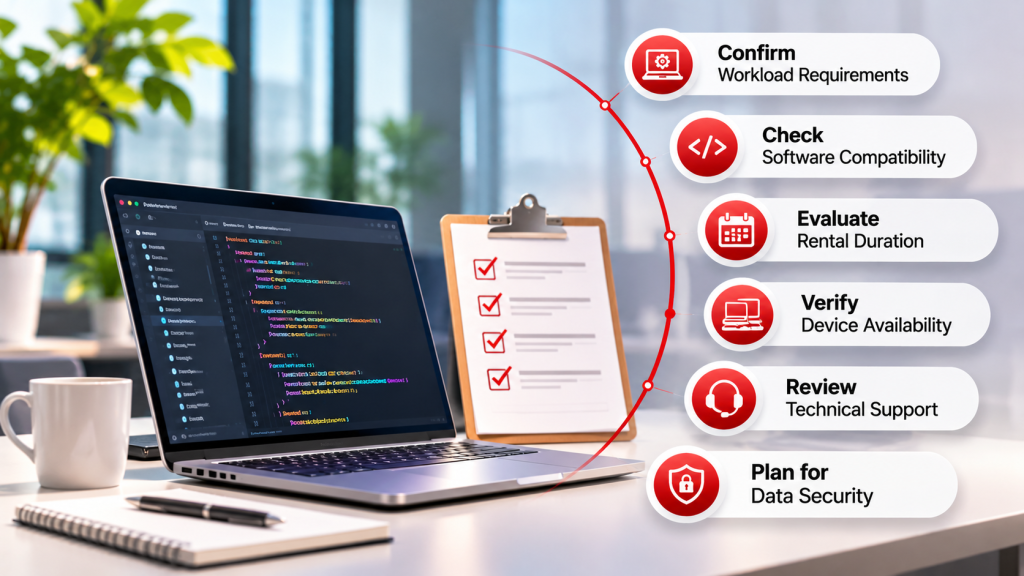
Before finalizing a rental arrangement, companies should consider several factors.
Confirm workload requirements: Consult technical leads to identify essential processor, memory, storage, GPU, and operating system specifications.
Check software compatibility: Ensure the selected hardware supports the required development tools and operating system versions.
Evaluate rental duration: Compare rental costs with the expected useful life and utilization of the equipment.
Verify device availability: Confirm the quantity, specifications, and delivery feasibility with the rental provider.
Review technical support: Understand troubleshooting procedures, replacement conditions, and service responsibilities.
Plan for data security: Establish appropriate access controls, encryption, backups, and secure data removal procedures before returning devices.
By considering these factors, companies can avoid both unnecessary hardware expenditure and performance-related disruptions.
Corporate Device Standardization and Team Flexibility
A well-planned corporate IT strategy does not necessarily require identical laptops across every department.
Instead, organizations can create standardized hardware categories based on development responsibilities.
For example, a company may define three equipment groups:
- Standard development devices: For frontend developers, basic backend tasks, and routine programming.
- Advanced development devices: For full-stack teams, complex local environments, and mobile application development.
- High-performance systems: For AI/ML workloads, graphics development, and other computationally demanding tasks.
This approach simplifies procurement while allowing flexibility for specialized assignments.
Moreover, IT administrators can maintain consistent security policies, software deployment processes, and support procedures across each category.
As a result, businesses can improve hardware planning without unnecessarily restricting their development teams.
Common Questions About Developer Laptop Requirements
What Are the Best Laptops for Software Developers?
The best laptops depend on the developer’s workload.
For general programming, a modern processor, 16GB RAM, and 512GB SSD can provide a practical starting point. However, mobile development, complex backend systems, and AI workloads may require additional memory, storage, or dedicated graphics hardware.
Therefore, the most suitable laptop is one that meets the actual software and performance requirements of the development role.
Is 16GB RAM Enough for Software Development?
Yes, 16GB RAM is sufficient for many everyday programming tasks, including web development and moderate multitasking.
However, developers running multiple virtual machines, containers, large development environments, or Android emulators may benefit from 32GB RAM or more.
The appropriate capacity depends on the number and type of applications running simultaneously.
Do Software Developers Need a Dedicated Graphics Card?
Most general programming tasks do not require a dedicated GPU.
However, machine learning, game development, GPU computing, and certain graphics-intensive workflows may benefit from dedicated graphics hardware.
Businesses should confirm GPU compatibility and memory requirements before selecting these devices.
Is a MacBook Better Than a Windows Laptop for Programming?
Both platforms support many programming languages and development tools.
MacBooks are particularly relevant for developers working with Xcode and Apple’s application ecosystem. Meanwhile, Windows laptops offer a broad selection of configurations for enterprise development, web applications, and many specialized workloads.
Ultimately, software compatibility, performance requirements, and team preferences should guide the decision.
When Is Laptop Rental for Developers Better Than Buying?
Renting can be useful when companies need laptops for temporary projects, contract developers, short-term expansion, or specialized workloads.
In contrast, purchasing may provide better long-term value when employees use the same equipment consistently over several years.
Companies should compare total costs, maintenance responsibilities, flexibility, and expected equipment utilization before deciding.
Where Can Companies Rent Laptops for Software Development in India?
Companies looking for corporate development hardware can explore IndiaRENTALZ, which provides laptop, MacBook, desktop, and workstation rental solutions for businesses.
IndiaRENTALZ supports IT equipment rental requirements across India, including bulk deployments and different hardware configurations based on availability.
Businesses can share their development workloads, required specifications, quantities, delivery locations, and rental duration to request suitable equipment options.
Visit www.indiarentalz.com to explore available rental solutions.
Building More Efficient Development Teams With the Right Hardware
Selecting laptops for software development involves more than choosing the latest processor or purchasing the most expensive device.
Different development roles require different hardware capabilities, and businesses benefit from understanding these requirements before investing in equipment.
While frontend developers may work efficiently with mid-range laptops, backend developers, mobile engineers, and AI specialists may need more powerful configurations.
Therefore, companies should focus on workload compatibility, performance, project duration, and equipment utilization.
With proper planning, Laptop Rental for Developers can help organizations accommodate changing technical requirements while maintaining greater flexibility in their IT infrastructure.
Looking for laptops, MacBooks, or high-performance workstations for your development team?
Explore corporate IT rental solutions with IndiaRENTALZ and request a quotation based on your team’s technical requirements.