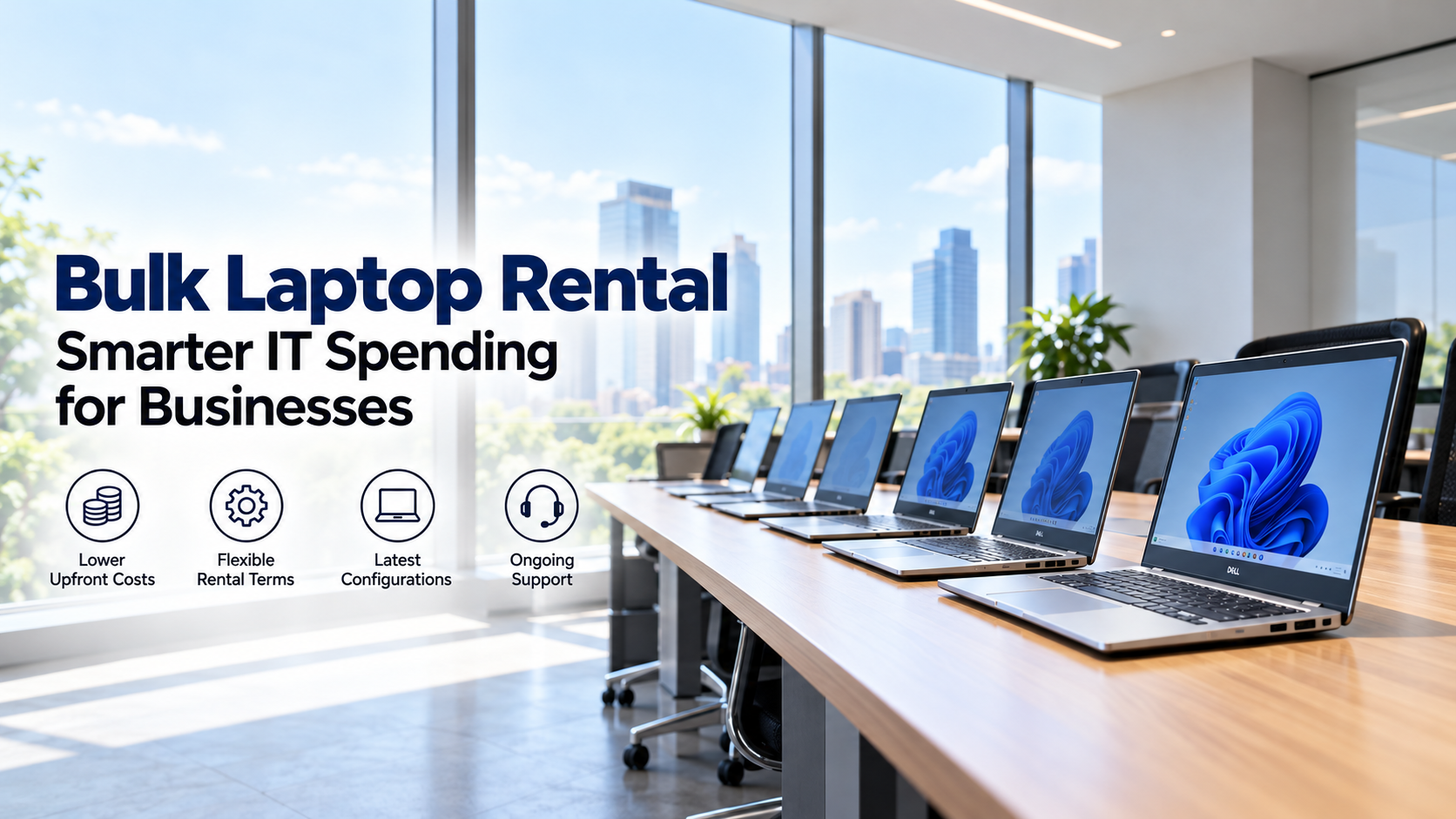
Technology has become one of the most important operating expenses for modern companies, which is why IT rentals for businesses are gaining attention as a more flexible way to manage technology costs. Whether a business is onboarding new employees, expanding into another city, running a short-term project, or building a distributed workforce, every new device adds to the total cost of IT operations.
However, the actual cost of purchasing laptops, desktops, workstations, and other equipment extends far beyond the invoice value. Maintenance, depreciation, upgrades, storage, repairs, and unused assets can gradually increase the total investment.
Instead of committing substantial capital to devices that may only be needed for a limited period, companies can use rental models to align technology spending more closely with their actual workforce and project requirements.
Under the right circumstances, the difference in total cost can be significant and may reach around 40% compared with purchasing. However, the actual saving depends on rental duration, device specifications, utilisation, support requirements, and the company’s existing IT infrastructure.
IT Rentals for Businesses Reduce Upfront Capital Costs
Purchasing technology usually requires a considerable upfront investment. For example, onboarding 50 employees may require a company to purchase 50 laptops immediately, even if some of those employees are working on short-duration projects.
Consequently, a large amount of capital becomes locked into depreciating assets.
With IT rentals for businesses, companies can convert a major capital expenditure into a more predictable operating expense. Instead of paying the full device cost at the beginning, they pay according to the agreed rental period.
This approach can be particularly useful for:
- Startups managing limited working capital
- Companies expanding rapidly
- Project-based teams
- Seasonal workforce requirements
- Training programmes
- Temporary offices
- Remote employee deployments
As a result, businesses can preserve capital for recruitment, product development, marketing, expansion, or other strategic priorities.
The Purchase Price Is Only Part of the Real IT Cost
A common mistake in IT budgeting is comparing the monthly rental amount only with the purchase price of a device.
However, purchasing equipment creates additional costs throughout its lifecycle.
These commonly include:
- Initial purchase expenditure
- Device configuration
- Maintenance
- Repairs
- Spare parts
- Battery replacement
- Technology upgrades
- Asset tracking
- Storage
- Depreciation
- Disposal or resale
Therefore, the relevant comparison is not simply rental price versus purchase price. Instead, businesses should evaluate the total cost of ownership, or TCO.
For example, a laptop that costs ₹60,000 today may continue generating expenses for several years. At the same time, its resale value continues to decline.
An IT equipment rental for companies model can simplify several of these variables because the equipment remains tied to the duration for which the business actually needs it.
IT Rentals for Businesses Limit Depreciation Exposure
Technology depreciates quickly.
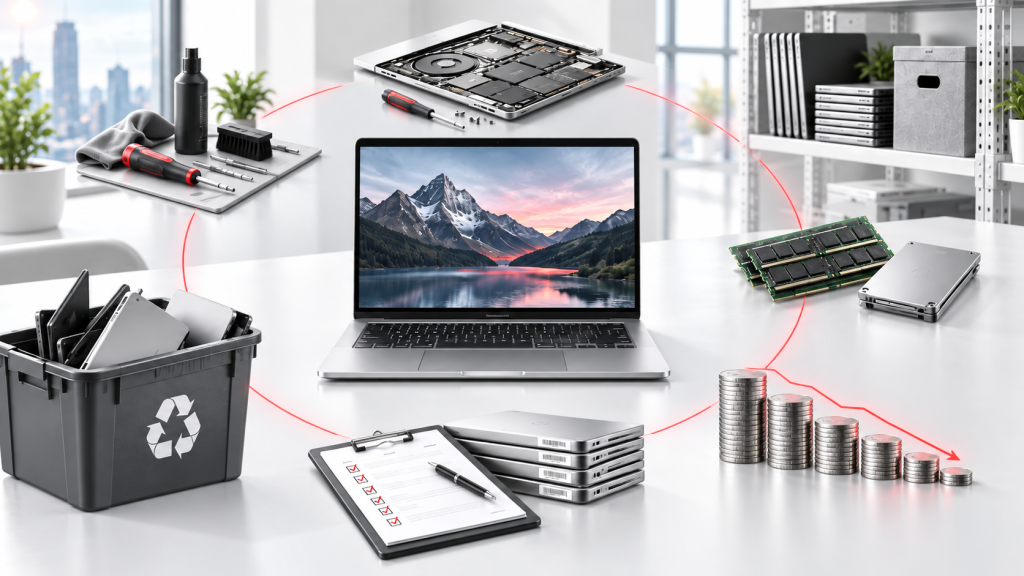
A laptop purchased today may still function perfectly after three years, yet newer processors, security capabilities, operating systems, and software requirements can reduce its practical value within the organisation.
Furthermore, companies purchasing large device fleets carry that depreciation directly on their assets.
With IT rentals for businesses, depreciation risk largely remains outside the customer’s asset portfolio. The company uses the device during the agreed rental period and can return or replace it when its requirement changes.
This distinction becomes especially relevant for organisations that need current-generation systems for demanding workloads such as:
- Software development
- Video production
- 3D rendering
- Architecture
- Engineering
- AI workloads
- Data processing
Instead of repeatedly purchasing new high-performance systems, the organisation can select devices based on current workload requirements.
Flexible Device Allocation Reduces Idle IT Assets
Unused devices are one of the most overlooked technology expenses.
Consider a company that hires 30 employees for a six-month project. If it purchases 30 laptops, those devices remain company assets even after the project finishes.
Unless another team immediately requires them, the laptops may remain in storage.
However, the company still carries:
- Depreciation
- Asset management responsibility
- Storage requirements
- Maintenance
- Security concerns
Rental models provide a different approach.
A business can arrange devices for the project duration and return them when the assignment ends. Therefore, spending more closely reflects actual utilisation.
This flexibility can substantially improve cost efficiency for businesses with fluctuating workforce requirements.
IT Rentals for Businesses Simplify Scaling
Growth rarely happens in a perfectly predictable pattern.
A company might have 40 employees today, add another 25 next month, and create a temporary 15-member project team shortly afterward.
If every expansion requires a new procurement cycle, the IT department must repeatedly manage vendor selection, approvals, purchasing, configuration, and deployment.
In contrast, IT rentals for businesses can make capacity planning more flexible.
Companies can increase or reduce the number of devices according to operational requirements. Consequently, IT infrastructure becomes more closely aligned with headcount.
This can be especially beneficial for rapidly growing companies and distributed teams because technology becomes a scalable resource rather than a fixed inventory.
Maintenance and Device Support Affect the Final Cost
Hardware failures are unavoidable.
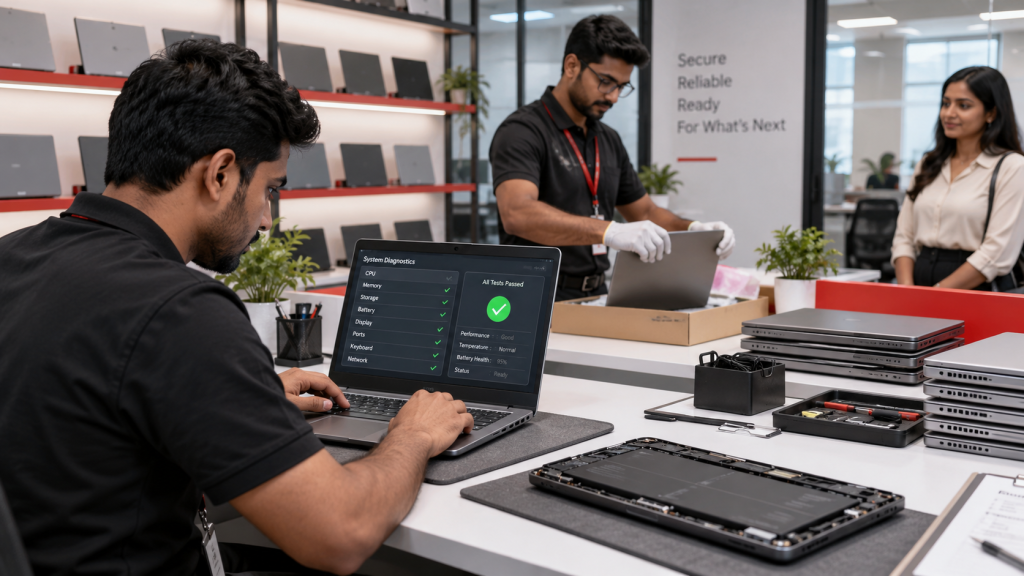
A damaged keyboard, battery issue, faulty SSD, display problem, or motherboard failure can create both direct and indirect costs.
The repair itself costs money. More importantly, employee downtime can affect productivity.
When companies own equipment, internal IT teams usually handle troubleshooting, vendor communication, spare parts, warranty status, and replacements.
However, depending on the rental agreement, IT equipment rental for companies may include support, replacement, maintenance, or device servicing.
Therefore, businesses should evaluate rental providers based on more than the monthly rental rate.
Important considerations include:
- Replacement policies
- Support response time
- Device testing procedures
- Maintenance coverage
- Availability of spare devices
- Delivery coverage
- Device configuration options
A slightly lower rental quote may provide limited value if replacement support is slow or unreliable.
Short-Term Requirements Create the Strongest Cost Advantage
Not every organisation should rent every device.
For stable employees who will use the same standard laptop for several years, purchasing can sometimes remain financially reasonable.
However, rental economics become much stronger when the requirement is temporary or uncertain.
Examples include:
- Three-to-six-month projects
- New teams awaiting permanent infrastructure decisions
- Training batches
- Contract employees
- Internships
- Temporary staffing
- Events and conferences
- Work-from-home deployments
- Disaster recovery requirements
In these situations, businesses avoid purchasing equipment that may become unnecessary shortly afterward.
Therefore, the potential cost advantage does not come only from a lower device price. It comes from eliminating unnecessary ownership.
A Practical Example of Rental Versus Purchase
Consider a business that requires 50 laptops for a nine-month project.
If each laptop costs ₹55,000, purchasing 50 devices requires an initial investment of:
₹55,000 × 50 = ₹27,50,000
However, that is only the acquisition cost.
The organisation may also face expenses related to configuration, repairs, storage, asset management, depreciation, and eventual resale.
More importantly, once the nine-month project finishes, the company still owns 50 laptops.
If there is no immediate requirement for those systems, the equipment becomes underutilised.
Alternatively, an IT equipment rental for companies arrangement allows the business to pay only for the agreed project period. Once the project ends, the devices can be returned.
Consequently, the organisation avoids both the large upfront purchase and the financial burden of unused equipment.
Depending on the device specification, contract duration, rental pricing, maintenance structure, and resale assumptions, the total cost difference can become substantial.
This is where the widely discussed potential of savings approaching 40% becomes relevant. However, companies should calculate their own TCO rather than assuming the same percentage applies to every requirement.
IT Rentals for Businesses Improve Budget Predictability

Unexpected IT costs make financial planning more difficult.
A company may budget for equipment purchases and later discover additional spending requirements related to repairs, batteries, upgrades, or replacements.
By contrast, IT rentals for businesses can create a more predictable expense structure.
Finance teams know:
- How many devices are being used
- How long they are required
- The agreed monthly rental
- The expected project cost
- When the equipment can be returned
As a result, forecasting becomes easier.
This predictability can also help CFOs and procurement teams connect technology expenditure directly with projects, departments, or employee headcount.
Choosing Between Rental and Purchase Based on Usage
The most effective IT strategy does not necessarily involve choosing only renting or only purchasing.
Many businesses benefit from a hybrid approach.
For example, a company might purchase equipment for permanent employees while renting additional devices for temporary teams and specialised workloads.
Purchasing may make more sense when:
- Device requirements remain stable for several years
- Employees use standard configurations
- The organisation has strong internal IT support
- Asset utilisation remains consistently high
Meanwhile, renting may be more suitable when:
- Requirements change frequently
- Projects have fixed timelines
- Teams scale quickly
- High-performance hardware is required temporarily
- Capital preservation is important
- Device quantities fluctuate
Therefore, organisations should evaluate technology based on utilisation period, not simply device ownership.
Common Questions About Business IT Rentals
Are IT rentals for businesses actually cheaper than buying?
They can be, particularly for short-term projects, temporary employees, rapidly changing teams, and specialised hardware requirements.
The financial benefit generally comes from avoiding large upfront purchases, depreciation, maintenance costs, unused equipment, and resale risk. However, long-term permanent requirements should be evaluated using a total cost of ownership calculation.
Can companies really save up to 40% by renting IT equipment?
Potentially, but 40% should not be treated as a guaranteed saving.
The actual percentage depends on factors such as device price, rental duration, configuration, maintenance, utilisation, depreciation, and resale value.
Businesses should compare the complete ownership cost against the complete rental cost for their specific requirement.
Which types of companies benefit most from IT rentals?
Startups, SMEs, rapidly expanding businesses, project-based organisations, training companies, enterprises with distributed teams, and companies hiring temporary employees often gain the most flexibility.
Additionally, businesses requiring expensive workstations or specialised systems for limited periods can avoid unnecessary long-term hardware investment.
Can rented laptops be used for long-term employees?
Yes. Although short-term projects often provide an obvious financial case, some organisations also use rental models for long-term workforce deployments.
The decision depends on device lifecycle strategy, support requirements, cash flow, upgrade frequency, and rental pricing.
What should businesses check before choosing an IT rental provider?
Companies should evaluate device quality, replacement policies, support response times, configuration availability, geographical coverage, maintenance terms, delivery timelines, and contract conditions.
Price matters, but service reliability is equally important because device downtime can affect employee productivity.
Where can companies rent laptops and IT equipment in India?
Businesses looking for laptops, MacBooks, desktops, workstations, servers, and other IT equipment can explore IndiaRENTALZ for business and enterprise rental requirements.
The appropriate configuration, quantity, and rental duration should be selected according to workforce size, software requirements, project duration, and deployment location rather than choosing devices based only on the lowest monthly rate.
Building a More Flexible IT Cost Model
Technology procurement has traditionally focused on ownership. However, modern businesses increasingly need flexibility rather than fixed inventories.
Teams expand and contract, projects begin and end, hardware requirements change, and newer technology regularly replaces older systems.
Therefore, companies should evaluate whether every device genuinely needs to become a permanent asset.
For organisations with fluctuating requirements, IT rentals for businesses can reduce capital commitments, improve hardware utilisation, simplify scaling, and make IT spending easier to forecast.
The greatest financial advantage comes from matching technology costs with actual usage. Instead of purchasing equipment first and finding a use for it later, businesses can deploy the devices they need, for the period they need them, and adjust their infrastructure as requirements change.