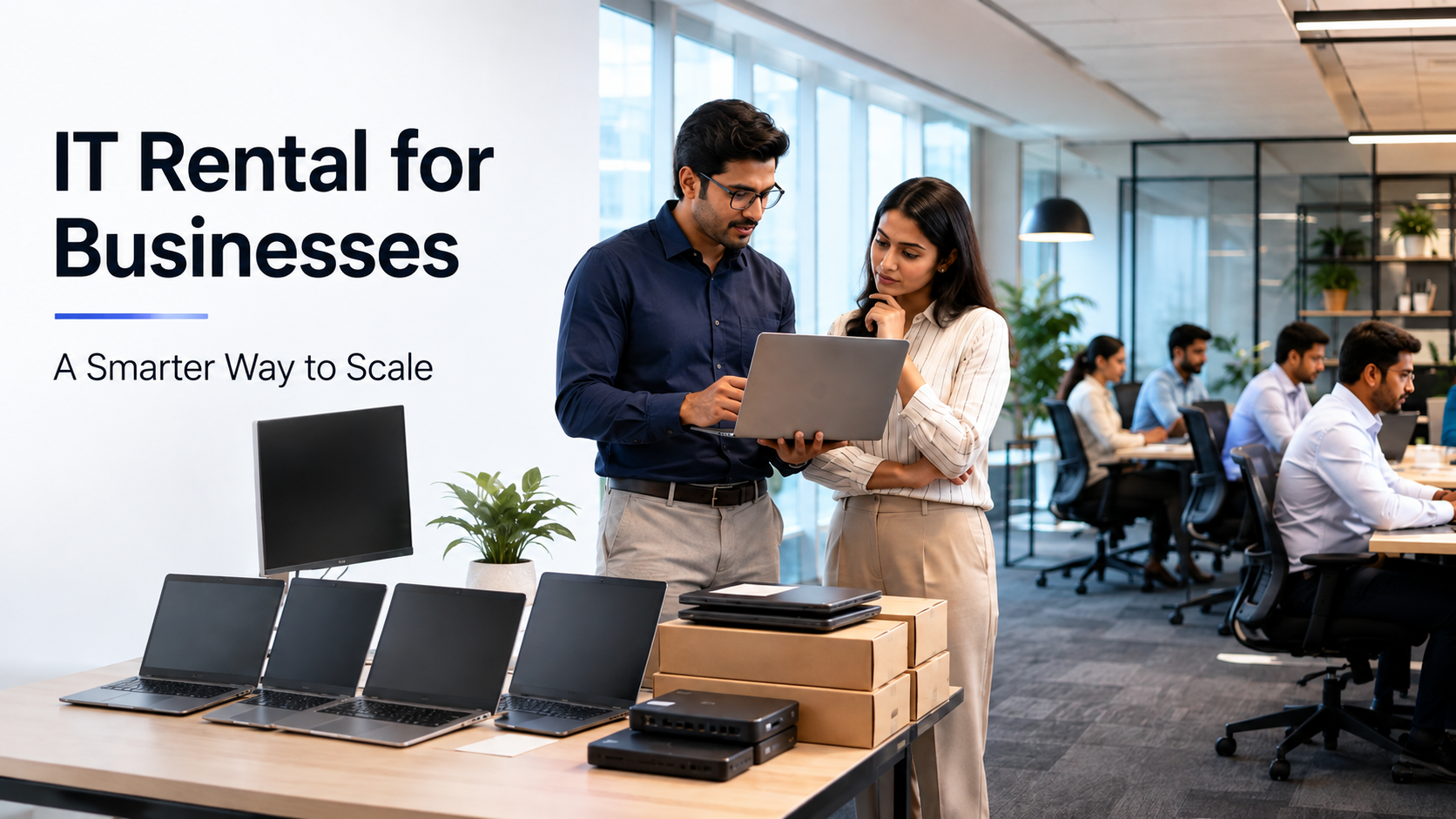
Technology requirements rarely stay fixed, which is why the benefits of IT rentals are becoming increasingly relevant for modern businesses. A company may hire 20 employees this month, open another office next quarter, run a three-month project, or suddenly need higher-performance devices for a new workload. In such situations, buying equipment for every requirement can create unnecessary costs, lock capital into depreciating assets, and leave businesses managing devices they may not need in the long term.
Renting gives companies a more flexible way to respond to changing technology needs. It can help businesses control capital expenditure, deploy devices faster, adjust configurations as requirements evolve, and reduce the operational effort involved in managing IT equipment.
At the same time, renting is not automatically the right choice for every organization. The decision depends on factors such as rental duration, device utilization, required specifications, support expectations, growth plans, and the company’s existing IT capabilities.
This guide explores the practical advantages of IT rentals and explains when flexible rental solutions can make more business sense than purchasing equipment outright.
Benefits of IT Rentals for Better Capital Planning
One of the biggest challenges with technology procurement is that businesses often spend a large amount upfront on assets that begin depreciating almost immediately.
For example, if a company needs 50 laptops for a temporary project, purchasing all 50 devices means committing capital before knowing how long those assets will remain productive.
Renting changes that model.
Instead of paying the full purchase cost at the beginning, businesses can spread technology expenditure across the required rental period. As a result, companies can preserve capital for other priorities such as:
- Hiring
- Marketing
- Product development
- Business expansion
- Working capital
- Training
- Operational expenses
This does not mean renting will always cost less over every possible period. However, for short-term, temporary, project-based, or uncertain requirements, it can reduce unnecessary capital lock-in.
For CFOs and finance teams, this flexibility makes technology budgeting easier to align with actual business usage.
Faster Device Deployment for Growing Teams
Business growth often creates sudden technology requirements.
HR may confirm 30 new joiners. A project manager may need an additional development team. A company may open a new branch. An event team may require laptops for a limited period.
In all these cases, the challenge is not simply finding devices. The real challenge is getting the right configuration ready at the right time.
IT rentals can simplify this process because businesses do not need to complete a full purchase cycle for every temporary requirement.
Depending on availability and configuration, rental providers can help businesses arrange equipment such as:
- Business laptops
- MacBooks
- Desktops
- Workstations
- Servers
- Printers
- Monitors
- UPS systems
- High-performance devices
Therefore, companies can respond more quickly when hiring or operational plans change.
This is particularly useful for HR, Admin, IT, and Procurement teams that need to coordinate technology deployment without delaying employee onboarding.
Benefits of IT Rentals During Workforce Changes

Modern workforces are more flexible than they were a few years ago.
Companies increasingly work with:
- Contract employees
- Consultants
- Interns
- Temporary teams
- Seasonal staff
- Project-based professionals
- Remote employees
Buying a permanent device for every temporary worker can create a mismatch between asset life and employee tenure.
For instance, purchasing a laptop for a six-month employee may leave the business with an unused asset after the project ends.
Renting can align device availability with the actual workforce period.
Therefore, businesses can increase or reduce the number of devices according to staffing needs without continuously adding permanent assets to their inventory.
This makes IT rentals particularly relevant for organizations where employee count changes frequently.
Flexible IT Rental Solutions Support Changing Specifications
Technology requirements can change just as quickly as workforce size.
A standard office employee may need an Intel Core i5 system with moderate RAM, while a video editor, developer, architect, designer, or data professional may require much higher performance.
Buying one fixed configuration for everyone can lead to either overspending or underpowered systems.
With flexible IT rental solutions, companies can select devices based on actual job roles.
For example:
- Office and administrative teams may need standard business laptops.
- Developers may require higher RAM and processor performance.
- Designers may need dedicated graphics.
- Video editors may require powerful GPUs and larger storage.
- Executives may prefer premium lightweight laptops or MacBooks.
- Training teams may prioritize standardized configurations across multiple systems.
Moreover, if requirements change later, a rental strategy can make upgrades easier than managing a large fleet of purchased equipment.
This helps IT teams build device configurations around actual workload rather than a one-size-fits-all policy.
Lower Risk of Idle Technology Assets
Unused devices can become an overlooked cost inside growing organizations.
A company may purchase laptops for a team and later reduce headcount. A project may end sooner than expected. Employees may switch roles. Hardware requirements may change.
The result can be devices sitting unused in storage.
These assets still represent money already spent. In addition, they continue to age even when they are not being used.
The benefits of IT rentals are especially relevant in situations where utilization is uncertain.
Instead of keeping equipment permanently, companies can rent according to the expected period of use. Once the requirement ends, the devices can be returned according to the agreed rental terms.
As a result, businesses can reduce the risk of paying for technology that no longer contributes to productivity.
Simpler Maintenance and Replacement Management
Owning IT equipment involves more than purchasing it.
Businesses also need to manage:
- Hardware failures
- Battery problems
- Keyboard issues
- Storage faults
- Performance degradation
- Repair coordination
- Spare devices
- Replacement requirements
For small IT teams, these tasks can become difficult as the device fleet grows.
Rental arrangements often include defined support and replacement processes depending on the provider and agreement.
Therefore, when a device develops a hardware issue, the business may have a clearer route for repair or replacement instead of independently managing service centers, spare inventory, and vendor coordination.
However, companies should review support terms carefully before signing any rental agreement.
Important areas to check include:
- Replacement turnaround time
- On-site support availability
- Damage policies
- Upgrade options
- Device health standards
- Escalation procedures
- Geographic service coverage
The value of a rental service depends heavily on the quality of support behind the equipment.
Benefits of IT Rentals for Multi-Location Operations
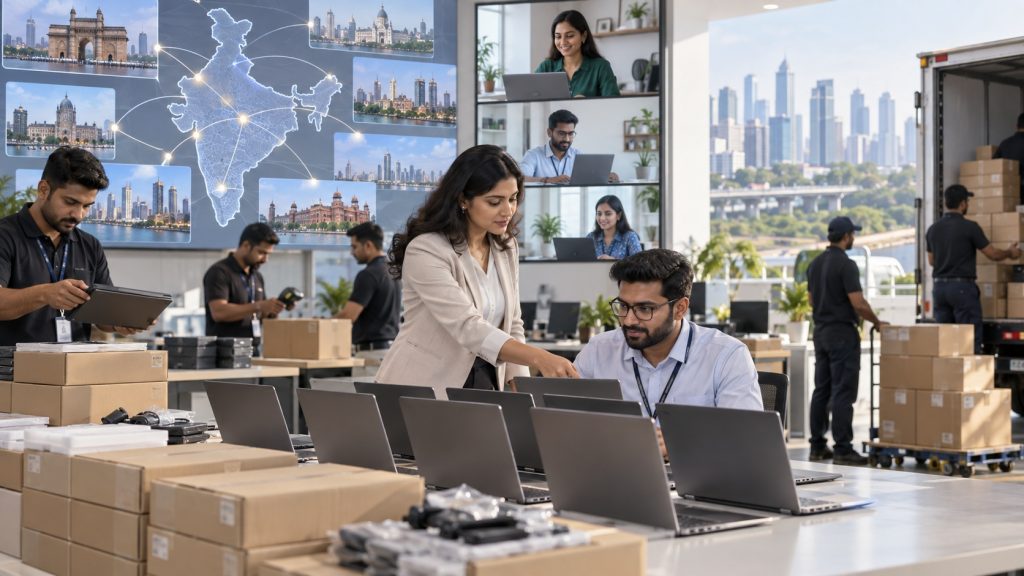
Managing technology becomes more complex when employees work from several offices or cities.
Companies may need devices delivered to:
- Head offices
- Branch offices
- Project locations
- Remote employees
- Client sites
- Training centers
- Temporary workplaces
If each location manages its own purchasing, businesses can end up with inconsistent configurations, multiple vendors, different service processes, and poor asset visibility.
A centralized rental strategy can simplify this.
Businesses can work with one technology partner to coordinate equipment across multiple locations while keeping specifications and processes more standardized.
For enterprises managing distributed teams, this can reduce the operational burden on central IT and Procurement departments.
It can also support expansion because companies do not need to build a complete local procurement network every time they enter a new city.
Technology Access Without Long Ownership Cycles
Technology changes quickly.
Processors improve. Memory requirements increase. Software becomes more demanding. New security standards appear. AI workloads may require more capable hardware.
When businesses own large device fleets, upgrading them can become expensive and slow.
In comparison, flexible IT rental solutions can give companies more freedom to match hardware with changing business requirements.
For example, a business might use standard laptops for routine operations but rent high-performance systems for:
- AI development
- Rendering
- Video production
- Data analysis
- Temporary engineering projects
- High-end design work
- Large training programs
This approach can help companies access specific technology when they actually need it rather than purchasing expensive equipment that may only be used occasionally.
When Renting Makes More Sense Than Buying
Although the benefits of IT rentals are significant in many situations, purchasing still has advantages.
Buying may make more sense when:
- Devices will be used continuously for several years.
- Hardware requirements are stable.
- The company has strong internal support capabilities.
- Asset ownership is strategically important.
- Devices have very high long-term utilization.
- The total lifetime purchase cost is clearly lower.
On the other hand, renting may be more practical when:
- Requirements are temporary.
- Headcount changes frequently.
- Project duration is uncertain.
- Deployment speed matters.
- Businesses want to avoid large upfront expenditure.
- Device specifications may change.
- Equipment is needed across multiple locations.
- Internal teams want less operational responsibility.
Therefore, the best approach is not always “rent everything” or “buy everything.”
Many businesses use a hybrid strategy.
They purchase devices for permanent, predictable requirements and rent equipment for temporary, high-growth, specialized, or variable needs.
This approach allows organizations to balance ownership with flexibility.
A More Practical Way to Evaluate IT Rentals
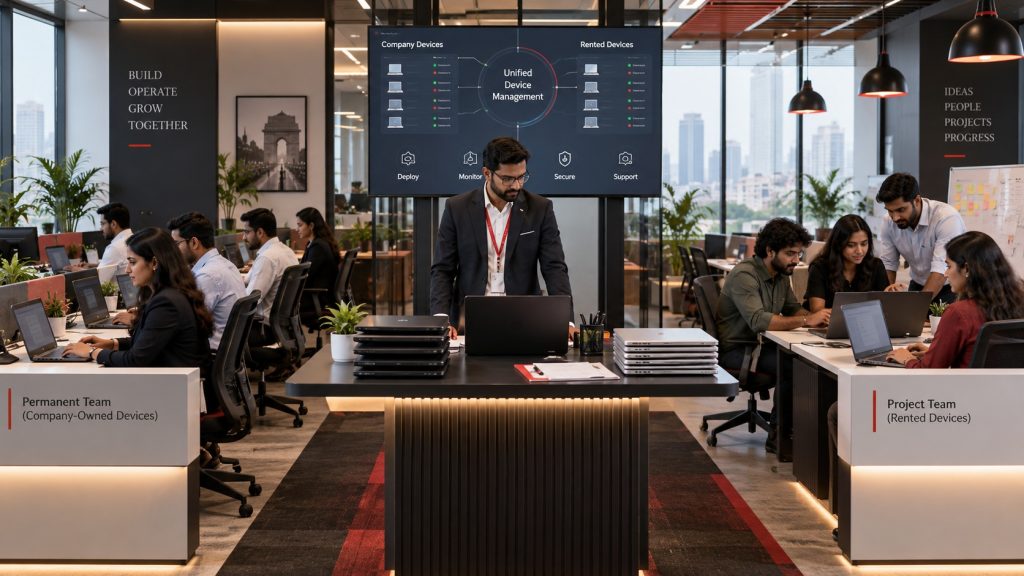
Before choosing a rental solution, businesses should evaluate the complete requirement rather than focusing only on monthly pricing.
Start by identifying:
- Number of devices required
- Processor requirement
- RAM
- Storage
- Graphics requirement
- Applications being used
- Rental duration
- Delivery locations
- Support expectations
- Expected start date
Then compare the overall cost and operational impact of renting versus purchasing.
For example, calculate whether ownership would also involve:
- Maintenance
- Repairs
- Spare devices
- Storage
- Asset tracking
- Depreciation
- Upgrade costs
- Disposal
- Internal IT time
This broader comparison gives decision-makers a more realistic view of technology cost.
Consequently, the decision becomes less about “Which option has the lowest monthly price?” and more about “Which option supports the business requirement most efficiently?”
Common Questions About Business IT Rentals
What are the main benefits of IT rentals for businesses?
The main advantages include lower upfront investment, easier scalability, faster deployment, reduced risk of idle equipment, configuration flexibility, and simpler support management.
However, the actual value depends on rental duration, equipment utilization, service quality, and the specific business requirement.
Are IT rentals better than purchasing equipment?
Neither option is universally better.
Purchasing can work well for stable, long-term requirements where devices will be heavily used for several years.
Renting can be more suitable for temporary teams, short projects, changing headcounts, specialized requirements, or companies that want greater technology flexibility.
Therefore, businesses should compare both cost and operational impact before deciding.
Can businesses rent equipment for temporary employees?
Yes. Temporary workforce requirements are one of the most practical use cases for IT rentals.
Companies can align the rental duration with internships, contracts, seasonal hiring, project staffing, or short-term expansion instead of purchasing permanent assets for temporary requirements.
Can IT rental configurations be customized?
Configuration availability depends on the rental provider and current inventory.
However, businesses can generally communicate requirements such as processor, RAM, storage, operating system, graphics capability, quantity, and rental duration.
This is why sharing complete usage information is important before finalizing a device.
Where can businesses rent laptops and IT equipment in India?
Businesses looking for laptops, MacBooks, desktops, servers, printers, workstations, GPUs, monitors, UPS systems and other IT equipment can explore rental options through IndiaRENTALZ.
The company provides IT rental solutions for business requirements across India, including bulk deployments, temporary workforce needs, projects, training, and corporate technology requirements.
You can explore available rental solutions at IndiaRENTALZ.com and share your required configuration, quantity, location, and duration to evaluate the most suitable option.
Choosing Flexibility Without Losing Control
Technology decisions should support business operations rather than create unnecessary financial or administrative pressure.
The benefits of IT rentals become most valuable when a company needs flexibility: changing team sizes, temporary projects, specialized hardware, multi-location deployment, or faster access to technology.
At the same time, renting should be evaluated with the same care as any other procurement decision. Businesses should compare tenure, utilization, support terms, configuration needs, and total cost before committing.
For many organizations, the most effective strategy may combine owned assets with rental equipment.
That way, permanent requirements remain stable while changing technology needs can be handled without turning every new requirement into a long-term purchase.