
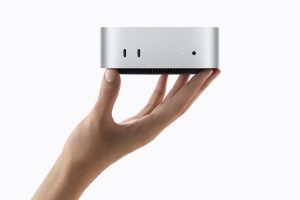
Apple has refreshed one of its smallest desktop computers with a major hardware upgrade. The Mac Mini M6 brings Apple’s newest silicon to the compact Mac lineup, with stronger CPU and graphics performance, a greater focus on local AI processing, faster memory bandwidth, and upgraded connectivity.
Apple announced the new Mac mini on August 25, 2026, alongside a higher-performance M5 Pro version. Although the familiar compact design remains, the changes inside make this generation particularly relevant to developers, creative professionals, AI teams, startups, and businesses planning new Mac deployments. Pre-orders have already started, while availability in India begins on September 22, 2026.
For individual buyers, the new model raises the usual upgrade question. However, for businesses, another consideration matters just as much: whether the additional performance justifies purchasing new systems immediately or whether flexible deployment options make more sense.
A New Compact Mac Built Around M6
The biggest change is Apple’s new M6 chip. According to Apple, M6 uses a new 2-nanometre process and combines a larger 12-core CPU with a 12-core GPU and a Dual 16-core Neural Engine. The architecture targets everyday computing as well as increasingly demanding AI, development, and creative workloads.
In practical terms, Apple has added two CPU cores and two GPU cores compared with the previous standard Mac mini generation. Moreover, the GPU now includes Neural Accelerators in every core, which allows compatible AI workloads to use more of the system’s processing resources.
The core configuration includes:
- 12-core CPU
- 12-core GPU
- Neural Accelerators integrated into GPU cores
- Dual 16-core Neural Engine
- 16GB standard unified memory
- Up to 32GB configurable unified memory
- Up to 170GB/s unified memory bandwidth
Therefore, this generation is not simply a processor-name refresh. Apple has clearly designed M6 around workloads that increasingly combine traditional CPU computing, graphics acceleration, and local AI processing.
Mac Mini M6 Price in India and Availability
The Mac Mini M6 price in India starts at ₹99,900. Apple also lists an education price of ₹88,900 for eligible customers.
Meanwhile, buyers who require substantially more performance can consider the M5 Pro version. Apple lists the new Mac mini with M5 Pro from ₹2,09,900, while eligible education customers can get it from ₹1,97,900.
As of August 27, 2026, Apple’s announced starting prices are:
- Mac mini with M6: ₹99,900
- Mac mini with M6 — Education: ₹88,900
- Mac mini with M5 Pro: ₹2,09,900
- Mac mini with M5 Pro — Education: ₹1,97,900
Apple opened pre-orders on August 25. However, customer deliveries, Apple Store availability, and availability through authorised resellers are scheduled to begin on September 22, 2026.
Actual pricing can increase when buyers select additional memory, storage, networking, or other configure-to-order options. Therefore, organizations planning multiple units should compare configurations based on workload rather than selecting upgrades automatically.
Mac Mini M6 Brings a Bigger CPU and GPU
Apple’s performance claims show where the company expects users to notice the largest improvements.
Compared with the M4 generation in Apple’s specified testing, the new system can deliver up to 40% faster CPU performance, up to 2x faster graphics, and up to 4x faster AI performance. Apple also claims up to 2x faster storage performance in certain configurations and workloads.
These numbers require context because benchmark results do not translate equally across every application. Nevertheless, the increased CPU and GPU resources should benefit workloads such as:
- Software compilation
- Large spreadsheets
- Photo editing
- Video production
- Code development
- Local AI processing
- GPU-accelerated applications
- Multitasking across professional applications
For example, Apple says the new machine delivers up to 1.5x faster Microsoft Excel spreadsheet calculation performance than M4 in its testing. It also reports up to 2x faster ray-traced gaming performance in Cyberpunk 2077: Ultimate Edition.
Consequently, users upgrading from significantly older Intel, M1, or early Apple silicon systems will likely notice a greater difference than users already working comfortably on recent M-series machines.
Memory and Storage Become More Important for Professional Work
Apple includes 16GB of unified memory as standard, while buyers can configure the system with up to 32GB. In addition, M6 raises unified memory bandwidth to as much as 170GB/s.
Memory configuration deserves particular attention because users cannot treat unified memory like conventional desktop RAM that can simply be upgraded later.
For general productivity, browser-based applications, office software, and lighter development, 16GB may remain sufficient for many users. However, professionals working with large media files, local AI models, development environments, or memory-intensive applications should evaluate 24GB or 32GB configurations more carefully.
Similarly, storage requirements depend heavily on workflow. Teams that store most data in cloud platforms may need less internal capacity. In contrast, video editors, designers, developers, and users working with large local datasets may benefit from greater SSD storage.
Therefore, buyers should configure the Mac according to real workloads rather than focusing solely on processor performance.
Mac Mini M6 Pushes On-Device AI Further
AI represents one of the biggest themes of this generation.
The GPU introduces Neural Accelerators in each core, while the Dual 16-core Neural Engine adds another dedicated layer of machine-learning capability. Apple says this combination provides up to four times the AI performance of the previous M4 generation in its specified tests.
Apple also reports that M6 can deliver up to 4.8x faster LLM prompt processing in LM Studio compared with M4 under its test conditions.
That makes the system potentially useful for developers and technology teams working with:
- Local large language models
- AI-assisted development
- Image enhancement
- AI agents
- Machine-learning applications
- Private on-device processing
- Automated creative workflows
Moreover, Apple provides development frameworks such as Core ML, Core AI, Metal, and Xcode that can use the chip’s CPU, GPU, and Neural Engine capabilities. As a result, developers can build applications that process more AI workloads locally rather than depending entirely on cloud infrastructure.
However, businesses should still evaluate model size, memory requirements, and software compatibility before treating a compact desktop as a replacement for dedicated AI infrastructure.
Connectivity Gets More Business-Ready
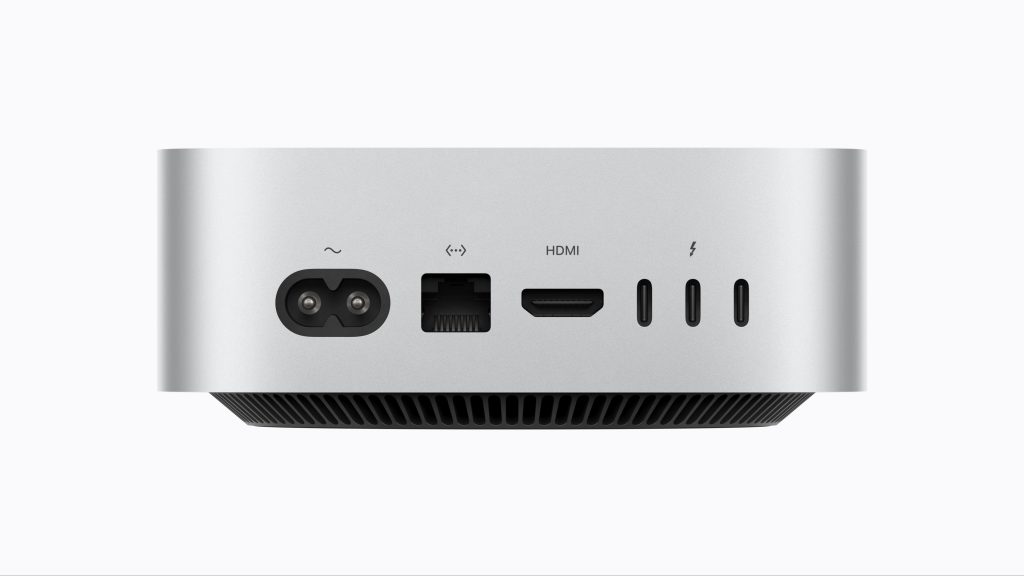
Connectivity also receives a meaningful refresh.
Both new variants now support Wi-Fi 7, Bluetooth 6, and 2.5Gb Ethernet as standard, with a configurable 10Gb Ethernet option. Therefore, teams working with network storage, high-speed office networks, large project files, or local servers gain more networking flexibility.
The front provides:
- Two USB-C ports supporting USB 3
- 3.5mm headphone jack
Meanwhile, the rear of the M6 model includes:
- Three Thunderbolt 4 ports
- HDMI
- Ethernet
The M5 Pro configuration steps up to three Thunderbolt 5 ports, which better suits high-bandwidth professional workflows.
As a result, the compact chassis can support fairly sophisticated desk setups without requiring a conventional tower computer.
M6 and M5 Pro Target Different Types of Users
The newest chip is not automatically the most powerful option in the lineup.
While the standard model receives M6, Apple positions M5 Pro above it for heavier professional workloads. The M5 Pro configuration supports up to an 18-core CPU, 20-core GPU, 64GB of unified memory, and 307GB/s of memory bandwidth.
Therefore, the standard M6 model should suit users focused on productivity, development, mainstream creative work, and moderate AI workloads.
M5 Pro, on the other hand, makes greater sense for workloads such as:
- Complex software development
- Large-scale video production
- 3D rendering
- VFX
- Scientific simulations
- Larger local AI models
- Large professional datasets
Apple also equips the M5 Pro version with Thunderbolt 5, which creates another reason for professionals with demanding external storage or display requirements to consider the higher-tier model.
In other words, businesses should select the chip based on workflow rather than assuming that M6 must always outperform an M5 Pro system.
Mac Mini M6 for Business and Team Deployments
For businesses, compact dimensions and strong performance can make the Mac Mini M6 attractive as a fixed workstation.
Software development teams can pair it with existing displays and peripherals. Creative teams can use it for editing and design workloads. In addition, organizations building controlled desk-based environments may prefer a compact desktop because the machine remains at the workplace rather than travelling with the employee.
The new connectivity options also improve its suitability for office environments. Faster Ethernet, Wi-Fi 7, multiple USB-C connections, HDMI, and Thunderbolt allow companies to integrate the machine with displays, storage devices, and network infrastructure.
However, organizations planning dozens of systems should consider more than specifications.
IT and procurement teams should evaluate:
- Expected deployment period
- User workload
- Required memory and storage
- Existing monitors and accessories
- Software compatibility
- Employee location
- Internal support resources
- Upgrade cycles
- Overall procurement budget
Consequently, the ideal configuration for a developer may differ substantially from the configuration required by a designer, office employee, or AI engineer.
Buying and Renting Serve Different Deployment Needs
For an individual who expects to use the machine for several years, purchasing may remain the most practical route. Similarly, companies with predictable long-term requirements may prefer to purchase standardized configurations for permanent teams.
However, rental can become relevant when requirements are temporary or uncertain.
For example, a company may need Mac systems for a six-month development contract, a temporary creative team, an application-testing project, an event, or a short-term expansion. Purchasing new hardware for such requirements can leave devices underutilized after the project ends.
Therefore, businesses should compare ownership and rental according to the expected period of use rather than considering only the hardware’s purchase price.
Rental may be worth evaluating when:
- Teams are temporary or project-based
- Requirements change frequently
- Multiple systems are required together
- A company wants to test a Mac-based workflow
- Employees need devices for a limited contract
- Purchasing would create unused hardware later
Meanwhile, purchasing usually becomes easier to justify when the organization expects consistent utilization over several years.
Common Questions About the New Mac Mini
What is the Mac Mini M6 price in India?
The new M6 model starts at ₹99,900 in India, while Apple’s education price starts at ₹88,900 for eligible customers. Configure-to-order upgrades such as additional memory, storage, or networking can increase the final cost.
When can buyers get the new Mac mini in India?
Apple started accepting pre-orders on August 25, 2026. The machines are scheduled to begin reaching customers, Apple Stores, and authorised resellers from September 22, 2026.
Is Mac Mini M6 faster than the M4 model?
Yes, according to Apple’s testing. Apple claims up to 40% faster CPU performance, up to 2x faster graphics, and up to 4x faster AI performance in specified workloads compared with the M4 generation. Actual performance will vary depending on software, configuration, and workload.
Is the new Mac mini suitable for developers and AI workloads?
It can be a strong option for many development and local AI tasks. The 12-core CPU, 12-core GPU with Neural Accelerators, Dual 16-core Neural Engine, and up to 32GB of unified memory give developers significantly more local compute capability.
However, very large AI models or highly demanding technical workflows may benefit from the M5 Pro configuration, which supports up to 64GB of unified memory and substantially greater memory bandwidth.
Should a business buy or rent Mac systems?
The answer depends primarily on utilization.
Companies with permanent teams and predictable long-term requirements may find purchasing more suitable. Conversely, rental can make more operational sense for temporary employees, project teams, pilot programs, short contracts, and changing requirements.
Businesses should therefore compare tenure, configuration, quantity, support requirements, and expected usage before selecting either model.
Where can businesses rent Mac systems in India?
Businesses that require MacBooks, Mac mini systems, or other IT equipment for temporary or project-based requirements can explore IndiaRENTALZ at indiarentalz.com.
IndiaRENTALZ supports corporate IT rental requirements across India, including deployments for development teams, creative professionals, temporary employees, project teams, and distributed workforces.
Before finalising a rental provider, businesses should compare the required configuration, rental period, availability, delivery coverage, support terms, replacement process, and overall commercial conditions.
A Stronger Compact Mac for a Changing Workload
Apple’s latest Mac mini refresh brings more than a routine processor upgrade. M6 introduces additional CPU and GPU cores, a stronger Neural Engine architecture, higher memory bandwidth, and a clear emphasis on local AI workloads. At the same time, Wi-Fi 7, Bluetooth 6, faster standard Ethernet, and improved professional options make the platform more relevant to modern workplaces.
For individual buyers, the ₹99,900 starting price places the system in premium desktop territory, particularly once a display, keyboard, mouse, and configuration upgrades enter the calculation.
For businesses, however, the decision should go beyond the processor generation. Organizations should first identify the workload, expected period of use, required memory and storage, team size, and deployment model.
Ultimately, the new Mac mini offers a compelling combination of compact dimensions and substantial processing capability. Whether it makes sense to purchase immediately, continue using an existing Mac, choose M5 Pro, or deploy Macs through rental will depend on how much of that new performance the user can actually put to work.